| Status: | No longer meeting |
| Convenor: | |
| When: | Monthly on Wednesday afternoons 14:00-16:00 3rd Wednesday of the month |
| Venue: | Old Bluecoat School |
| Cost: | There will be a small cost of £2 per session from January 2025 to cover the cost of hire of the venue and refreshments. |

Thatcham u3a Science and Technology Group has now been operating for about one year. During that time we have had a presentation about pollution in the River Ganges. We have had numerous discussions about scientific and technological advances that we think may have a important impact on our lives particularly in our later years. These have included:
- The impact Artificial Intelligence (AI) will have on our lives. I think the general consensus was that we were worried about AI and the future.
- Global warming
- We discussed what we think the future of transportation will be like. Will self-drive cars become the norm? will we have our food/parcels delivered by drone?
- Do we think, with global population increase, that there is a danger to the world if we don't consider alternative protein sources beyond meat? Would you eat bugs to save the world? We even had a 'bushtucker trial' where our members tried out insect derived snack bars and compared them with standard snack bars. Most of us were happy to eat them and some even took home samples for their partners. WE did however turn our noses up at the dried mealworms and crickets.
We have had one site visit to Reading Hydro (see pictures below). Reading Hydro is a river micro hydroelectric scheme on the River Thames using the head of water provided by Caversham Lock/Weir. The scheme is owned and operated by the Reading Hydro CBS, a community benefit society founded in 2017.
WE have had one external speaker from the Thanes Valley Police Cyber Crime Unit about Online Security (more later).
The Science and Technology Group is taking a break over the summer (July and August meetings have been cancelled) and we may look for a better venue in September where we can encourage more external speakers. we may also explore another site visit, maybe to a waste disposal site, a sewage work or water treatment works.
If you are interested in the group please get in touch and if there are any burning Science & Technology Issue you think we should explore please let the convenor know.
OTHER USEFUL INFORMATION
The National u3a offer Online Learning Events. U3a members can access these free of charge via zoom. Some are Science & Technology related. Some interesting ones in July.
- Plants, medicine and magic - Explore how plants have contributed to the making of modern medicines in this Science Network talk by Dr Susan Burge. Tuesday, July 15 · 11am - 12:30pm GMT+1
- Technology in Sport - John Butler from u3a Let's Talk Tech looks at how technology is transforming athlete performance, officiating, and the fan experience. Wednesday, July 16 · 1 - 2:30pm GMT+1
Some of these might prompt us for subjects for future meetings.
https://www.u3a.org.uk/events/educational-events#Events
There is also the u3a Communities Group (putting University back into the u3a). Its a free, independent online platform offering members the opportunity to join in regular, lively meetings on a range of subjects including Science & Technology, Geology, Climate Crisis and Leading Edge. u3acommunities.org
LAST MEETING
The Science and Technology Group organised a talk on cyber security by Hiro Taylor of the
Thames Valley Police Cyber Security Team on 18 June 2025. Hiro originally came from the
Philippines but came to this country to study Computer Science at University. His first job
was as a ‘White Hat Hacker’. This is someone who is employed by companies to try to hack
their systems. If successful they then recommend solution to prevent these hacks taking
place. The ‘Black Hat Hackers’ are the criminals. Hiro them joined the police and helps
companies, organisations and individuals who have been hacked or scammed. Another
enjoyable part of his job is presenting to companies, organisations and charities on how to
be safe online.
His presentation was both informative and entertaining. He handed out a brochure with
advice on how to stay secure online. It contained 7 steps to protect yourself from most cyber
attacks.
Report suspicious messages – if you’ve received a suspicious email or text message
that doesn’t feel right, or visited a scam website, don’t panic.
1. Forward suspicious texts to 7726
2. Forward suspicious emails to
report@phishing,gov.uk
3. Report scam websites to the NCSC by visiting
ncsc.gov.uk/report-scam-website
4. If you think you’ve been a victim of fraud, contact your bank immediately and
report it to Action Fraud online at actionfraud.police.uk or by calling 0300 123
2040
Create a unique strong password for your email account – If a cyber criminal
accesses your email, they can use it to reset all your other account passwords.
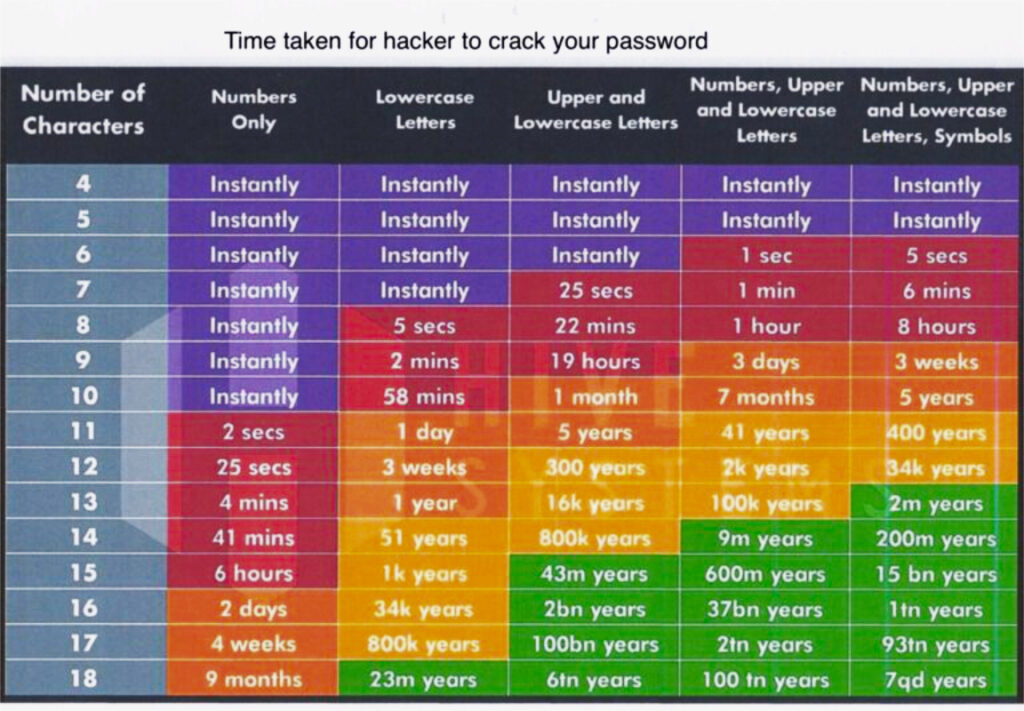
Create strong passwords – cyber criminals can easily guess weak, short passwords.
So, create a long password by combining three random words and include numbers
and special characters if allowed. e.g. Pudd1ngT0rchPizza!
Save Passwords in your browser – Most web browsers (such as Chrome, Safari and
Edge) will offer to save your passwords for you. It’s safe for you to do this. Letting
your browser do this means you can use unique, strong (and long) for all your
important accounts.
Turn on 2-step verification (2SV) wherever possible – 2SV simply means you’ll be
prompted for a second piece of information when signing into your account. This is
usually a code which will be sent via text or email.
Update your devices – you should update your apps and your devices software
when prompted. You can make things even safer by turning on automatic updates.
Make sure your important data is backed up – a backup is a copy of your important
data such as photos, documents and other personal data. Apple, Google and
Microsoft offer systems to be able to backup your data on the internet.
Following the Science and Technology meeting on Cyber Security the following information has been sent be the Thames Valley Cyber Crime Unit.
“Last week, nearly 16 billion passwords were leaked online - one of the largest data exposures ever recorded. And it’s not just from new incidents: cybercriminals are compiling old breaches into massive mega-dumps, making your information even easier to exploit.
Check if your data’s at risk:
- Visit Have I Been Pwned to see if you were caught up in a breach”
Also try out u3a Communties - Putting University back into u3a, u3a Communities is a free on-line platform for enquiring minds. It hosts a number of subject based groups who meet on-line monthly. It is independent of the Third Age Trust. https://u3acommunities.org


